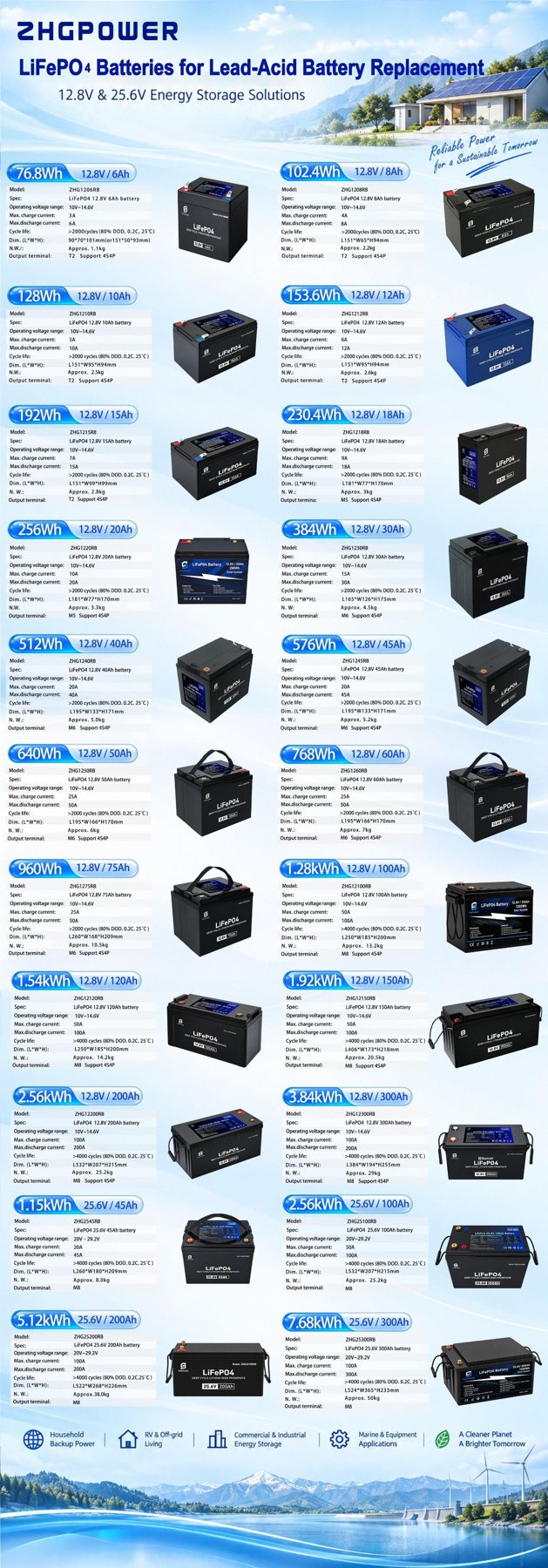
A LiFePO4 battery can be a useful replacement for a lead-acid system, but a “drop-in” claim is incomplete until the equipment, charger, controller, wiring, protection and operating environment have been checked together. The safest procurement question is not “Which lithium battery has the same voltage and case size?” It is “Which approved system configuration will deliver the required work, charge correctly, protect the equipment and remain serviceable in the intended location?” This article gives equipment owners and integrators a structured way to answer that question before they order samples or retrofit a fleet.
The assessment below is general engineering practice. It does not declare any particular battery compatible with any particular machine. Use the equipment manufacturer's requirements and the exact battery model's approved limits, drawings and reports. YZL POWER's product range includes 12.8V and 25.6V LiFePO4 replacement directions and application-specific battery engineering; final suitability and documentation must be verified for the selected model and market.
Start with a complete baseline of the existing system
Document the current lead-acid installation before choosing a replacement. Record the equipment model, application, number of batteries, series and parallel arrangement, nominal system voltage, existing battery chemistry and rating, measured compartment dimensions, cable route, connector and polarity, charger model, controller settings, required runtime and normal replacement interval. Photograph the nameplates and wiring. If batteries are paralleled, note cable lengths and connection points. If a machine has several operating modes, record which mode drives the highest power demand.
Do not rely only on the old battery's printed Ah figure. Lead-acid capacity is influenced by discharge rate and operating conditions, while usable energy and voltage behavior differ from LiFePO4. A nominal capacity comparison therefore does not settle runtime. Collect actual data where possible: current over a representative shift, time spent at high load, charger output, voltage at the controller and the lowest state of charge that operators normally reach. If no logging exists, plan a measured trial rather than inventing a conversion factor.
Identify the business objective as well as the electrical requirement. A buyer may want longer runtime, lower maintenance, reduced downtime, less weight, a different charging pattern or more predictable performance. Those goals have different implications for design and cost. A battery that saves weight but forces a charger replacement may still be attractive; a battery that fits the case but cannot communicate with a critical controller is not. Agree on how success will be measured before comparing quotations.
Build a baseline worksheet
Include operating hours per day, days per week, time between charges, opportunity-charging windows, peak and average loads, seasonal temperature, vibration, dust and water exposure, installation orientation, service access and expected annual volume. Add any braking energy returned to the DC bus. For backup applications, include time between outages, load variation and whether the battery remains on float or standby for long periods. Record the acceptable machine behavior when the battery is near its protective limit.
The baseline worksheet should distinguish measured values from estimates. Label each line “measured,” “manufacturer specification,” or “assumption,” and state who owns it. A supplier can then identify what must be tested in a sample. This small discipline prevents a preliminary sales estimate from becoming an accidental design requirement. It also lets competing suppliers quote against the same duty and boundary conditions.
Understand the voltage window, not just nominal voltage
The label “12V,” “24V” or “48V” is a category, not a complete electrical interface. A LiFePO4 pack and a lead-acid bank can share a nominal system class while having different voltage curves, charge limits, low-voltage behavior and protection thresholds. The equipment may accept a wide bus range or it may have narrow cutoffs. Obtain the permitted input-voltage range, start-up behavior and overvoltage response of the host. Compare those with the exact proposed pack's operating range under load, charge and recovery.
Check the charger separately. Its output voltage, current, charging algorithm, temperature compensation and restart logic must suit the approved LiFePO4 system. A lead-acid charger that performs equalization or uses an unsuitable float profile should not be assumed safe merely because its connector fits. Some chargers can be reprogrammed; others need replacement. The decision should be recorded in the retrofit scope with a tested model and settings, not left to an installer to improvise.
Measure voltage at the host terminals during starts and peaks. Cable and connector resistance can create a larger drop than expected, particularly when a lithium pack permits a higher instantaneous current than the old system delivered. If the host trips while the BMS reports adequate state of charge, trace voltage at both ends of the cable and inspect connections. If the BMS itself disconnects, compare the current and duration with its approved limits and the actual load. These are different problems and require different remedies.
Size energy from the duty cycle
Start with the energy the equipment must deliver over a shift or backup event, then account for the permitted usable window, conversion losses, reserve and conditions that reduce available performance. Power integrated over time gives the energy demand; an Ah label alone does not. A machine with brief heavy lifts and long idle periods differs from one that draws moderate power continuously. Two applications with identical peak current can need very different energy capacities.
Define a repeatable operating cycle for testing. For a warehouse vehicle, that might include travel, lifting, loaded travel, idle time and charging breaks. For a telecom backup cabinet, it might include a normal standby period, discharge at the actual site load, recovery charge and a second outage scenario. For a floor-cleaning machine, it might include propulsion, brush, vacuum and water-pump loads. The point is not to apply a universal cycle but to capture the buyer's real work in a reproducible form.
Use the resulting measurements to choose the pack capacity and reserve. State the required minimum runtime and the test conditions: starting state of charge, ambient temperature, equipment load, operator pattern and end criterion. A sample trial should report delivered energy and voltage behavior, not just the number of hours a machine happened to run on one day. If runtime is close to the threshold, account for production variation and aging with the project's agreed margin.
Avoid a misleading one-to-one Ah conversion
Lead-acid and LiFePO4 discharge characteristics differ, so “replace 100Ah lead-acid with 100Ah lithium” is not a design rule. It may be too much, too little or physically incompatible depending on current, voltage thresholds and duty cycle. A more reliable comparison uses measured energy demand and the usable energy available within each system's approved operating envelope. The supplier should explain the assumptions behind any proposed capacity and show how they will be verified on the equipment.
Similarly, a lighter pack is not automatically a mechanical advantage. Removing a heavy lead-acid battery from a forklift or other counterbalanced machine may change stability or axle loading. The equipment manufacturer or a qualified engineer must assess the weight and center-of-gravity consequences. For a mobile robot, lower mass may help energy efficiency but can affect traction and dynamics. Treat the battery as a structural and operational component, not a detachable commodity.
Check current, peaks and regeneration
List continuous current, start-up current, motor stall or acceleration peaks and their durations. Include simultaneous loads and the worst credible operating combination. Compare these with the battery's approved discharge limits at the relevant temperature and state of charge. The BMS may protect the pack by disconnecting at a threshold that is appropriate for the cells but disruptive to the machine. The system design must coordinate BMS protection with host warnings and controlled shutdown where the application requires it.
Some industrial drives return energy to the DC bus during braking, lowering or other regenerative events. The battery must be able to accept that energy under the conditions in which regeneration occurs, including high state of charge or low temperature. If it cannot, the controller may require another energy path or a revised operating strategy. This is a system-level question for the equipment OEM and battery engineer; a battery brochure cannot resolve it.
Do not attempt to defeat or raise a BMS protection threshold simply to make a trial pass. First determine whether the load profile was correctly measured, whether cable and connector losses are excessive, whether the selected pack has sufficient current capability and whether the host has a proper response to limits. A protection change requires a documented engineering review, a revised configuration and a retest plan.
Review control and communication requirements
Many older lead-acid installations provide little more than power terminals and perhaps a temperature sensor. Modern equipment may also need CAN, RS485, UART or discrete signals for state of charge, warnings, current limits and fault reporting. Identify what the existing controller expects and what the proposed LiFePO4 BMS provides. A shared connector shape or a statement that both sides “support CAN” does not prove message compatibility.
For closed-loop integration, confirm protocol version, message IDs, data scaling, update rate, bus termination, pinout, fault mapping, charger coordination and behavior when communications are lost. Test the exact machine controller and firmware that will be used in the field. If the equipment uses an estimated state of charge derived from lead-acid voltage, it may display misleading information after conversion. Decide whether to integrate BMS data, update the display logic or train operators on a different indication.
For simpler voltage-only systems, specify thresholds and test the equipment through a complete work and charge cycle. How does it warn the operator before the battery disconnects? Can it restart safely after a low-voltage event? Will it unexpectedly resume movement or load after charging begins? The absence of digital communication makes these operating behaviors more important to document and witness.
Confirm mechanical fit and installation
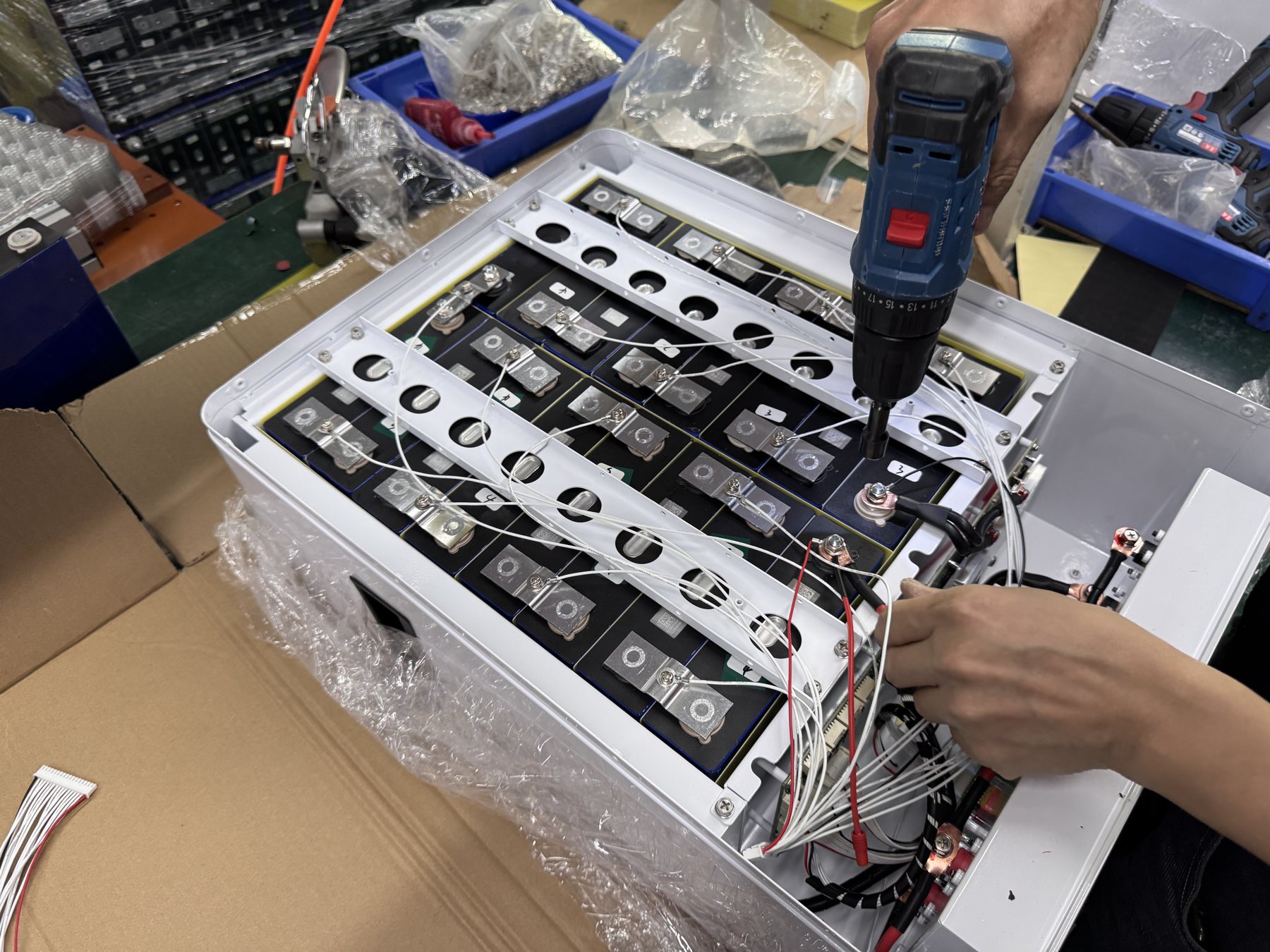
Measure the actual battery bay, not only the old battery's catalog dimensions. Include tolerances, terminals, handles, mounting brackets, access doors, cable bends, cooling space and removal route. Check connector orientation and polarity with a controlled drawing. A battery that physically enters the bay may still obstruct a service panel or require a tight cable bend. Avoid adapter harnesses whose current rating, retention and strain relief have not been engineered.
Review enclosure protection, vibration, shock and thermal conditions for the application. An indoor UPS cabinet, outdoor telecom enclosure, warehouse robot and industrial vehicle need different evidence. The selected pack's ingress rating and operating temperature must be appropriate for the actual installation; the relevant rating should be specified and supported for the model, not inferred from a photograph. Check whether the battery can be charged at the site temperature and whether the charger follows any required inhibit or conditioning behavior.
Consider maintenance and operator workflow. Is there a safe disconnect? Can technicians reach labels and service points? Are chargers and connectors clearly identified so an old lead-acid charger cannot be used accidentally? If batteries are swapped between machines, what prevents the wrong revision or chemistry from being installed? A retrofit is not complete until the site has a practical identification and training plan.
Treat parallel and series arrangements as engineered systems
Replacing several lead-acid units with several lithium packs in a string or parallel bank is not automatically equivalent to using one larger pack. Confirm whether the exact battery model is approved for the proposed series or parallel arrangement, how current sharing is managed, how individual packs are protected and how a pack can be isolated. A generic claim that “LiFePO4 can be paralleled” is insufficient. Ask for the model-specific wiring diagram, maximum configuration and commissioning procedure.
In a parallel installation, differences in cable resistance and state of charge can influence current sharing. In series, the combined voltage range and independent protection events can affect the host. A pack disconnecting while others remain connected may create unexpected system behavior. Test the actual arrangement under charge, discharge and fault conditions. Where multiple packs are supplied, identify them by serial number and keep their firmware and configuration under control.
If the project includes a high-voltage system, use qualified personnel and the appropriate design and safety standards. This article does not provide instructions for assembling or rewiring high-voltage battery strings. The purchasing team should require a complete system design, installation procedure and evidence package from the responsible engineers before approving such a conversion.
Compare lifetime value without invented savings
A replacement business case can include battery purchase price, charger and controller changes, installation labor, downtime, maintenance, energy use, replacement frequency, transport, training and end-of-life handling. The outcome depends on the equipment and operating schedule. Avoid a universal percentage saving or fixed payback claim unless the calculation is supported by site data and a clearly stated methodology.
Ask each supplier to quote the same scope. One offer may include charger integration and testing while another covers only a battery in a case. A lower unit price can leave the buyer responsible for unexpected engineering work. Separate nonrecurring engineering, sample units, production units, spare parts, documentation and after-sales arrangements. Record what is included in commissioning and what support is available after installation.
Use a sensitivity check. How does the business case change if the equipment runs fewer shifts, if the charger must be replaced, if a mechanical bracket is needed, or if the useful life differs from the forecast? These scenarios help management see which assumptions matter. The result should guide a pilot, not substitute for it. A field trial supplies the evidence needed to refine the assumptions.
Build a retrofit acceptance plan
Start with a bench review of electrical interfaces, charger behavior, BMS settings, labels and mechanical drawings. Then install one controlled sample on a representative machine with appropriate supervision. Record the exact machine and firmware, pack serial number and revision, charger settings and test equipment. Run a normal shift, the highest-load period, the charging pattern and a controlled low-energy scenario within approved limits.
Capture current, voltage at the battery and host, temperature, state of charge, alarms and operator observations. Compare the measured runtime and behavior with the agreed baseline. If the sample fails, document the fault and cause before changing settings. A successful adjustment creates a new revision and an affected-test list. Repeat enough work cycles to identify intermittent communication, charging or mechanical problems that a short demonstration might miss.
Before a fleet rollout, test a production-intent configuration and define the inspection route for every unit or lot. Confirm that installers have the correct drawings, connectors, torque requirements, configuration files and serial-number recording process. A staged deployment lets the team monitor the first machines before the whole fleet is converted. Establish a rollback or containment procedure if a serious integration problem appears.
A concise acceptance matrix
| Question | Evidence to request | Decision owner |
|---|---|---|
| Does the pack fit and remain serviceable? | Installation drawing, measured clearances and trial photographs | Equipment engineer |
| Does the host accept the full voltage window? | Host specification and logged operating test | Electrical engineer |
| Does the charger follow the approved profile? | Charger model, settings and witnessed charge trace | Battery and charger teams |
| Are peaks and regeneration handled? | Current and voltage traces in the actual duty cycle | System engineer |
| Are warnings and faults understood? | BMS/host logs and controlled state tests | Controls engineer |
| Is runtime sufficient? | Repeatable work-cycle result with stated conditions | Operations owner |
| Are documents model-specific and current? | Report and label review against exact configuration | Quality or compliance owner |
| Is support ready? | Case template, service contact and approved warranty terms | Procurement and service owner |
The matrix is deliberately short. A complex machine may need many more rows, and an application with safety-critical behavior needs a stronger validation program. The value of the matrix is that each decision is tied to evidence and an accountable person rather than a vague supplier assurance.
Review documentation and shipping scope
Ask for the exact model's available transport and safety documents and confirm what the destination, carrier and customs process require. UN38.3 testing, a test summary, an MSDS and a transport appraisal are not interchangeable. Their applicant, manufacturer, model, capacity, report date and scope must match the battery being shipped. A report for a different capacity or an earlier configuration does not establish coverage of the proposed retrofit pack.
Certification claims must be specific. A cell certificate may concern the cell, not the assembled battery or machine. A supplier assessment may concern a company or facility, not every product. The buyer should request the actual file and check its validity and scope. YZL POWER's material should be reviewed by model and market. If an existing transport document is expired, obtain an updated acceptable document before shipping rather than presenting the old file as current.
Plan packaging and handling for the selected battery and shipment mode. The supplier, carrier and recipient should agree on labels, state of charge where applicable, packaging, damage response and document handoff. The on-site team should know not to return a damaged lithium battery through an ordinary parcel route without written guidance. Keep these logistics requirements in the purchase and support plan, not as an afterthought once the hardware is ready.

Plan support and operator training
A retrofit changes how the machine behaves near low energy and during charging. Train operators on the new display or state-of-charge indication, safe charging practice, warning response and the conditions that require stopping use. Provide maintenance staff with the battery model, connector drawing, approved charger configuration and a way to identify firmware or hardware revisions. If the machine previously used lead-acid watering or equalization routines, update the maintenance procedure accordingly.
Define how faults will be reported. A useful report contains machine and battery serial numbers, order reference, charger and controller models, firmware, date and operating mode, recent changes, alarm codes, BMS and host logs, measured voltage, current and temperature, and photographs of wiring and surroundings. Preserve evidence from the first event when safe to do so. Assign who diagnoses the machine, battery, charger and installation so no issue is lost between suppliers.
Agree on warranty in the signed commercial documents for the specific configuration and use. Do not infer a universal period or unconditional replacement promise from a general article. In the event of smoke, swelling, leakage, unusual odor or uncontrolled heating, follow the site's emergency plan and prioritize safety. Remote troubleshooting should begin only after the immediate hazard has been controlled by qualified personnel.
Frequently asked retrofit questions
Can a same-voltage LiFePO4 battery simply replace my lead-acid unit?
Sometimes a conversion is straightforward, but voltage label and case size alone cannot establish compatibility. The charger, full voltage window, current peaks, controller thresholds, physical mounting and protection behavior must be reviewed. Obtain the equipment and battery specifications and run a controlled sample test. Treat “drop-in” as a hypothesis to validate for the exact machine, not as an unconditional product property.
Can we keep the old lead-acid charger?
Only if its actual profile and controls are confirmed suitable for the approved LiFePO4 pack and the complete charge cycle is tested. A charger may have an equalization or float behavior that is unsuitable, or its restart logic may conflict with BMS protection. Ask the battery and charger teams for a written configuration. If the existing unit cannot meet it, include a replacement charger in the project.
Will the same Ah rating provide the same runtime?
Not reliably. Runtime depends on measured equipment power, usable energy within the approved voltage and protection limits, temperature, losses and operating pattern. Compare energy delivered during a representative cycle and specify the test conditions. A supplier can propose an initial capacity, but the machine trial should decide whether it meets the required shift or backup period.
What if the machine has no CAN or RS485 interface?
A voltage-only integration may be possible for some equipment. It requires careful coordination of charger settings, host thresholds, operator warnings and BMS protection. Test how the machine behaves at low energy, after a protective disconnect and during recovery. Lack of digital communication does not remove the need for system validation.
Can several replacement packs be connected in parallel?
Use only a configuration explicitly approved for the exact model and tested with the proposed wiring and charger. Ask for the permitted number of packs, connection method, current-sharing approach and fault behavior. Do not generalize from one product or chemistry to another. Series configurations and high-voltage work require particular engineering and safety controls.
Which documents should be requested before export?
The answer depends on the destination, carrier, mode of transport and exact model. Request the current model-specific test summary and other required transport and safety files, then verify applicant, manufacturer, capacity, date and scope. Obtain carrier confirmation where needed. Do not treat a general company certificate or a report for a related model as a substitute.
Decide with a controlled sample, then scale
A strong retrofit decision starts with a baseline, converts that baseline into measurable system requirements, evaluates the proposed LiFePO4 configuration on the actual equipment, and freezes the accepted version before a wider rollout. The result is a documented answer about a machine and use case, not a generic claim about chemistry. The same method makes supplier quotations comparable and later support more effective.
For a project review, send the existing battery and equipment labels, charger model, wiring and bay photographs, measured duty cycle, required runtime, destination and expected order quantity. YZL POWER can review application requirements, available lead-acid replacement options, OEM/ODM engineering and model-specific documentation. For a deeper sample release process, read the industrial battery pilot validation plan. The 48V project-definition guide can help structure the first technical inquiry.
Discuss your conversion: Email taokun@xhlmarketing.com or WhatsApp +86 138 0280 9405. Ask for a configuration review based on the exact equipment and charger rather than a universal compatibility promise.